
One or more of Mimecast’s email servers appear to be listed in Backscatterer’s RBL blocklists, affecting deliver of emails from customers who utilise the services of Mimecast. Our team has notified Mimecast and will provide further feedback.
DuZeru OS: As Easy as It Gets
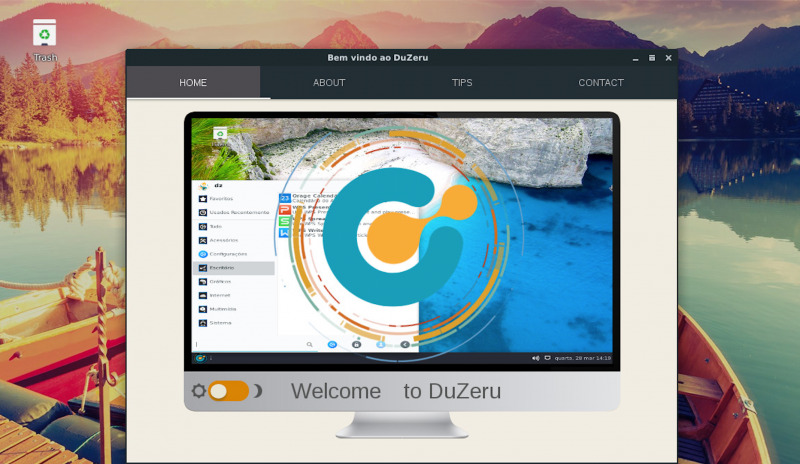
There are seemingly countless Linux distributions on the market, each one hoping to carve out its own little niche and enjoy a growing user base. Some of those distributions have some pretty nifty tricks up their sleeves, while others are gorgeous works of art on the desktop. Still, others go to great lengths to simply be a desktop distribution capable … Read More
Red Hat Enterprise Linux 7.6 Enters Beta with Linux Container Innovations
Red Hat announced today the availability of Red Hat Enterprise Linux 7.6 operating system for beta testing for Red Hat Enterprise Linux customers. Red Hat Enterprise Linux 7.6 is the sixth maintenance update in the Red Hat Enterprise Linux 7 operating system series, promising innovative technologies for Linux containers and enterprise-class hybrid cloud environments, new security and compliance features, as … Read More
5 Essential Tools for Linux Development
Linux has become a mainstay for many sectors of work, play, and personal life. We depend upon it. With Linux, technology is expanding and evolving faster than anyone could have imagined. That means Linux development is also happening at an exponential rate. Because of this, more and more developers will be hopping on board the open source and Linux dev … Read More
5 Reasons You Should Switch From Windows To Linux Right Now
When I published the highlights of my journey switching from Windows to Linux on my everyday laptop, I was floored at the engagement it received across all corners of the web. I also voiced an admittedly wrong assumption within the article itself that it wouldn’t attract many eyeballs, and yet it became one of my most viewed pieces this year. From where … Read More
Google Data Transfer Project will help you move your data between services
Your personal data is under constant attack. A week doesn’t go by without news of yet another massive personal data breach. The only person who can’t get at your data, it seems, is you. Google, in partnership with Microsoft, Twitter, and Facebook, will be changing that with the open-source Data Transfer Project (DTP). This project is developing tools that will enable … Read More
The Linux Foundation Transforms the Energy Industry with New Initiative: LF Energy
We are thrilled to introduce the new LF Energy initiative to support and promote open source in the energy and electricity sectors. LF Energy is focused on accelerating the energy transition, including the move to renewable energy, electric mobility, demand response and more. Open source has transformed industries as vast and different as telecommunications, financial services, automobiles, healthcare, and consumer products. Now we are … Read More
Red Hat Enterprise Linux 6 & CentOS 6 Patched Against Spectre V4, Lazy FPU Flaws
Users of the Red Hat Enterprise Linux 6 and CentOS Linux 6 operating system series received important kernel security updates that patch some recently discovered vulnerabilities. Now that Red Hat Enterprise Linux 7 and CentOS Linux 7 operating system series were patched against the Spectre Variant 4 (CVE-2018-3639) security vulnerability, as well as the Lazy FPU State Save/Restore CPU flaw, it’s time for Red Hat … Read More
Containers or virtual machines: Which is more secure? The answer will surprise you
Are virtual machines (VM) more secure than containers? You may think you know the answer, but IBM Research has found containers can be as secure, or more secure, than VMs. James Bottomley, an IBM Research Distinguished Engineer and top Linux kernel developer, writes: “One of the biggest problems with the current debate about Container vs Hypervisor security is that no-one has actually … Read More
Supercomputers: All Linux, all the time
Once more, if you want to run the fastest possible computer, the June 2018 TOP500 supercomputing ranking shows that Linux is the best of all operating systems. Every last one is running Linux. Linux has dominated supercomputing for years. But, Linux only took over supercomputing lock, stock, and barrel in November 2017. That was the first time all of the TOP500 machines were … Read More
Security-Oriented Alpine Linux Can Now Be Installed on Raspberry Pi 3 Model B+
A new stable version of Natanael Copa’s security-oriented Alpine Linux operating system has been released with support for Raspberry Pi single-board computers and various updated components. Alpine Linux 3.8 is out as the most advanced version of the GNU/Linux distribution, bringing, for the first time, an ARM64 (AArch64) image designed for deploying the operating system on Raspberry Pi devices. Best … Read More
Civil Infrastructure Platform, Keeping the Lights On with Linux
Modern civil infrastructure is all around us — in power plants, radar systems, traffic lights, dams, weather systems, and so on. Many of these infrastructure projects exist for decades, if not longer, so security and longevity are paramount. And, many of these systems are powered by Linux, which offers technology providers more control over these issues. However, if every provider … Read More
Ubuntu Is Used All over the World, Reveal Initial Ubuntu 18.04 Desktop Metrics
Canonical revealed today the initial desktop metrics that it gathered from Ubuntu 18.04 LTS users since the release of the operating system in April 2018. During the development cycle of Ubuntu 18.04 LTS (Bionic Beaver), Canonical announced that there would be an optional personal and system data collection tool implemented in the operating system to help them improve Ubuntu. Later, closer to the final … Read More
5 open source alternatives to Dropbox
Dropbox is the 800-pound gorilla of filesharing applications. Even though it’s a massively popular tool, you may choose to use an alternative. Maybe that’s because you’re dedicated to the open source way for all the good reasons, including security and freedom, or possibly you’ve been spooked by data breaches. Or perhaps the pricing plan doesn’t work out in your favor for the amount … Read More
SUSE Introduces Multimodal OS to Bridge Traditional and Software-Defined Infrastructure
SUSE today launched SUSE Linux Enterprise 15, the latest version of its flagship operating platform that bridges next-generation software-defined infrastructure with traditional infrastructure technologies. The modern, modular operating system helps simplify multimodal IT, makes traditional IT infrastructure more efficient and provides an engaging platform for developers. As a result, organizations can easily deploy and transition business-critical workloads across on-premise and … Read More
